

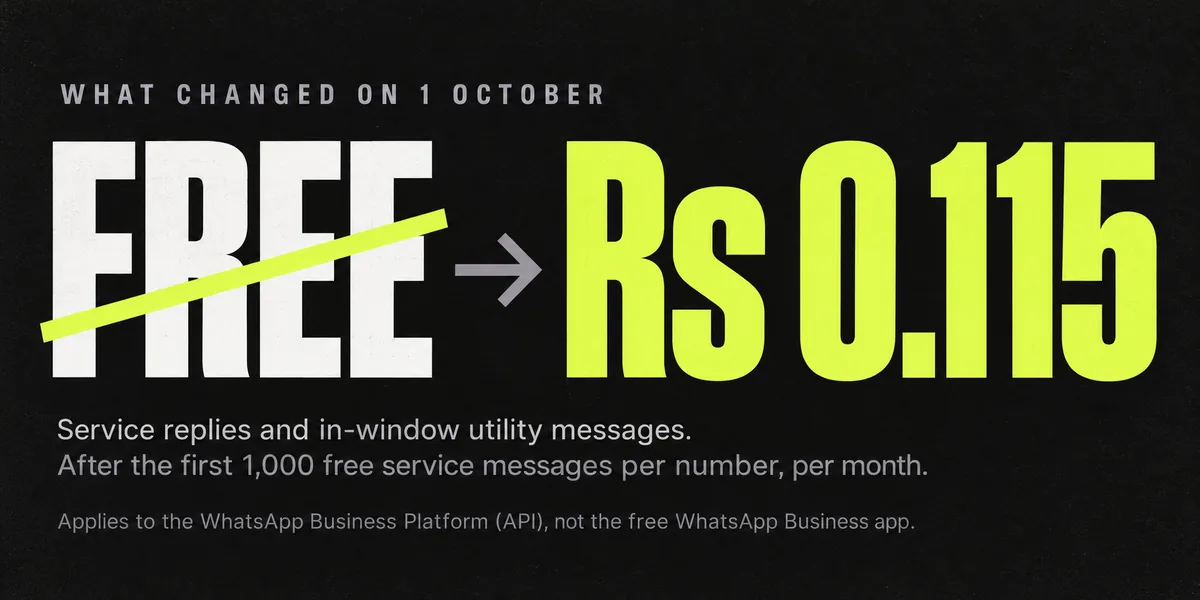
Meta started charging for messages that used to be free. Here is what changed, what it costs in India now, and what you actually own on this channel.
WhatsApp Business API pricing changed on 1 October 2026. Meta started charging for messages that used to be free. If you run a business on the WhatsApp API through a provider, your order updates and your support replies now cost money they did not cost in September. Most sellers have not opened their rate card yet.
This post pulls apart three things: what changed in the pricing, what you actually own on this channel versus what you are only renting, and the seven questions that tell you the difference before you sign or renew. It is adapted from an issue of my newsletter, Think With Shalin.
One note before we go in. Everything here applies to businesses running on the WhatsApp Business Platform, the API setup you connect through a provider to send broadcasts, automate flows, and plug WhatsApp into your store. If you use the free WhatsApp Business app from the Play Store or App Store to message customers by hand, none of this billing or ownership structure applies to you. This is for the businesses that outgrew that app.

The direction is one way. In July 2025, Meta stopped charging per 24-hour conversation and started charging per message. In October 2026, it went further and put a price on message types that most businesses had never paid for. The change was quiet. There was no dashboard banner for most sellers. The first many will hear of it is a line on the November invoice they cannot place.
Every current integration runs on Meta’s Cloud API. The older On-Premises API reached its final version and expired on 23 October 2025, and numbers still sitting on it stopped delivering. So this pricing applies to effectively every live WhatsApp API setup. Meta sets all of this out in its WhatsApp Business Platform pricing documentation.
Here is the rate card as it stands, for messages delivered to Indian numbers, before tax and before anything your provider adds on top.
| Message type | What it costs now | What changed |
|---|---|---|
| Service your replies inside the 24-hour window | First 1,000 per business phone number each month are free. After that, about ₹0.115 each. | Previously free |
| Utility inside an open service window | About ₹0.115 | Previously free in that window. Utility sent outside the window was always chargeable. |
| Authentication domestic | About ₹0.115 | Chargeable |
| Marketing | About ₹0.8631 | Unchanged |
| Meta Business Agent AI replies | About $2 per million tokens | New, billed separately |
Three things to do with that table this week.
Treat every figure above, including mine, as a reason to go and look. Meta publishes the current rate cards as downloadable files, India included.
Think of it as three landlords. You are renting three things from three different people, and you only ever compared one of them before you signed.
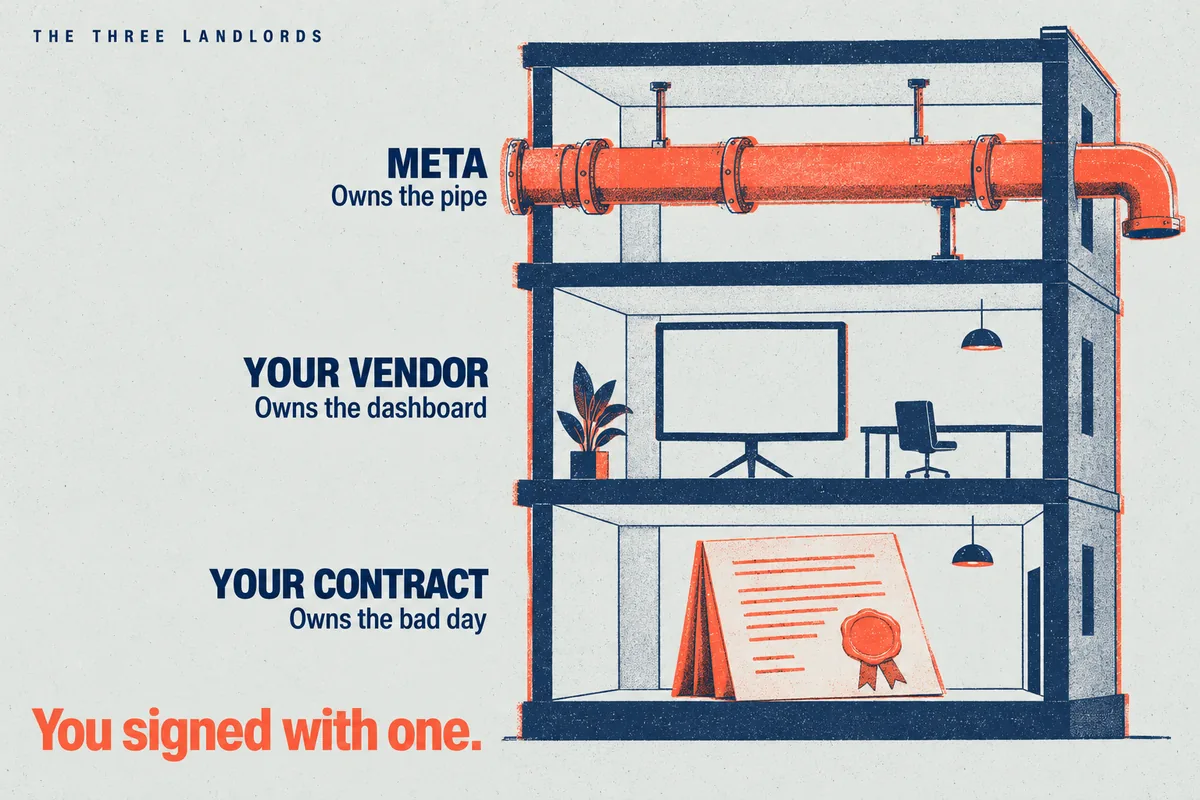
Meta decides whether your template is approved and in which category, your quality rating, your messaging limits, and how many promotional messages one person is allowed to receive before the next one is quietly withheld. Every WhatsApp Business Platform integration runs on Meta’s Cloud API. You cannot negotiate with this landlord. You can only work inside its rules.
Your provider owns the dashboard, the flows, the integrations, the reports, and how fast a human being actually looks at your problem. This is the only landlord you compared before buying. It is also the one you can change, and the one whose weaknesses show up last.
Your contract decides the margin on your messages, whose Meta business portfolio your account lives inside, what your support actually entitles you to in writing, and what you are allowed to carry out of the door if you leave. This is the landlord that decides what a bad month looks like. It is also the one almost nobody reads.
The paradox is simple. The easiest landlord to compare, the vendor, is the least likely to be the one that hurts you.
When that limit bites, your messages come back with reasons like “Unhealthy system activity” or “This message was not delivered to maintain healthy ecosystem engagement.” Read those again, because that is the wall. No vendor on earth can push a message past it.
What a good vendor can do is tell you what happened, tell you when to retry, and fix the category and cadence of your templates so it happens less often. What a weak one does is send you back to check your template and close the ticket. That gap is not a personality difference. It is a support commitment, which means it belongs in writing before you sign, not in a review after you have left.
Most people stay too long because they quietly believe leaving means losing everything. It does not. Based on the migration documentation published by the providers who run these moves, here is the split.
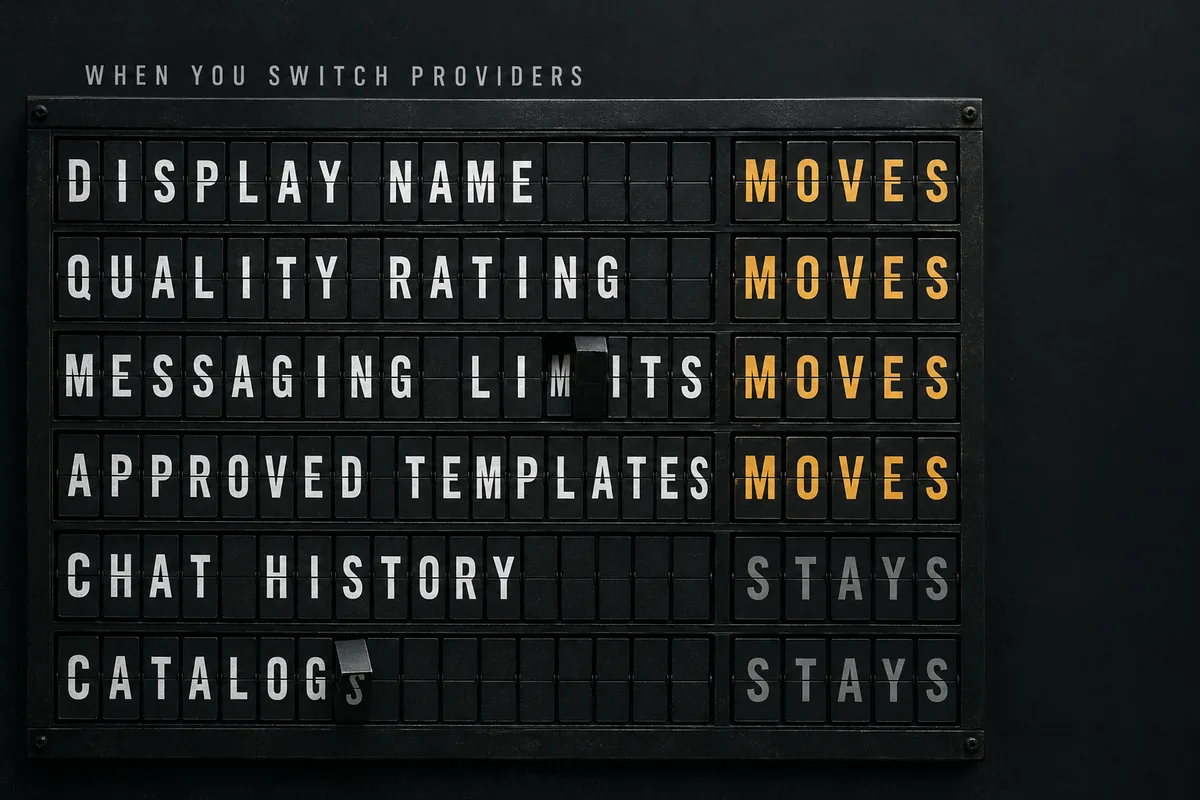
| What moves with you | What does not move |
|---|---|
| Display name | Rejected, pending and low-quality templates |
| The phone number’s quality rating | Catalogs |
| Messaging limits | Chat history |
| Official Business Account status | Flows rebuilt inside the vendor’s dashboard |
| Uploaded media | |
| Approved templates in good standing |
There are conditions. The business portfolio has to be verified, two-factor has to be off during the move, and the display name must be approved with no pending change request. Templates that do come across can be re-categorised or rejected at the destination, and they start on an unknown template quality rating for the first 24 hours. That rating belongs to the template and is separate from your number’s quality rating.
So your number is portable. Your history, your catalog, and every flow you rebuilt inside their dashboard are not. Your real switching cost was never the phone number. It was everything you built on top of a relationship you never read the terms of. For what a migration actually involves step by step, see one provider’s migration documentation.
Send these in writing, before you sign or renew. The answers will sort the market faster than any comparison article, and most of those are written by the vendors being compared.
A vendor who answers 1 and 3 in one clean line is a different kind of vendor from one who needs a call to explain it. Not automatically better at support. But you will know exactly what you are holding.
You are not buying a WhatsApp platform. You are buying a dashboard from one landlord, a pipe you do not control from another, and a set of terms that decide what happens on your worst day. Only one of those three is on the pricing page.
The pricing change already happened. Most people still have not checked. If you run any part of your business on WhatsApp, the move this week is small: find out whose Meta business portfolio your account is sitting inside, and get it in writing. That one answer tells you more than any feature list.
If you want the next breakdown like this, subscribe to Think With Shalin. Honest answers to marketing problems nobody breaks down properly.
Subscribe to Think With ShalinNo. The pricing change applies only to the WhatsApp Business Platform, the API setup you connect through a provider. The free WhatsApp Business app from the Play Store or App Store, used to message customers by hand, does not carry per-message charges and is not affected by this change.
From 1 October 2026, the first 1,000 service messages per business phone number each month are free. Service messages are your replies to customers inside the 24-hour service window. After the first 1,000, each service message costs about ₹0.115 for Indian numbers, before tax and provider margin.
The WhatsApp Business app is a free mobile app for messaging customers manually. The WhatsApp Business Platform is the API, connected through a provider, used to send broadcasts, automate flows, and integrate WhatsApp with your store. The pricing, ownership, and provider structure in this article apply only to the Platform.
Yes. Your phone number is portable between providers, and it keeps its quality rating, messaging limits, display name, and approved templates in good standing. What does not move is your chat history, your catalog, and any flows you built inside the old vendor’s dashboard. Conditions apply during the migration.
Meta Business Agent is the new AI reply feature on the WhatsApp Business Platform. It is billed separately from standard messages, at about $2 per million tokens rather than per message. If you have switched on automated AI replies, this is a cost that did not exist before and will not appear on a standard per-message rate card.
Meta’s documentation set 30 September 2026 as the deadline to attach a payment method to each messaging account. That date has passed. Your first 1,000 free service messages each month still send, but once you cross any paid threshold with no payment method on file, message delivery stops.
Marketing message pricing was unchanged in the 1 October 2026 update, at about ₹0.8631 for Indian numbers. Separately, Meta’s changelog shows India’s marketing rate rising on 1 January 2026 and the international authentication rate rising on 1 April 2026. Always check the live rate card, because rates are tiered and move.
Shalin Seb Raj is an AI Performance Marketer and Growth Marketer based in Kerala, India, with 7+ years in digital marketing for B2B, B2C, SaaS and ecommerce brands across 35+ countries.
Talks about the Performance & Growth in Marketing and AI that nobody breaks down properly through YouTube, Courses, Articles and the Newsletter.